

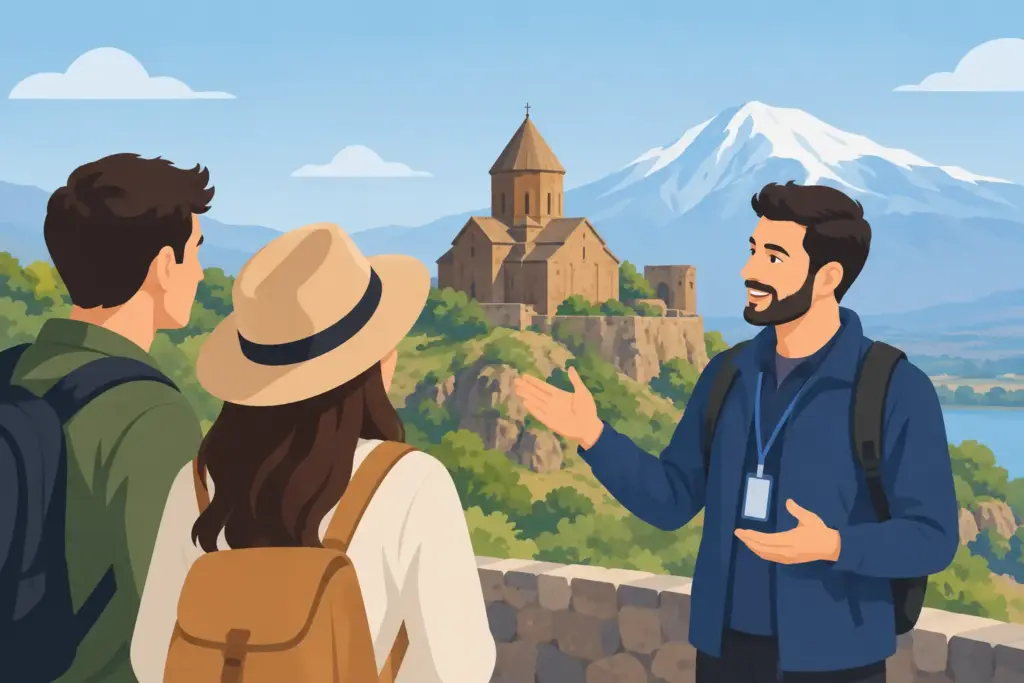
A guide is often the person who turns a beautiful stop into a meaningful memory. At Geghard Monastery, for example, you may see a remarkable medieval site on your own, but an English-speaking guide can explain why part of the complex is carved directly into rock, how it shaped Armenian religious life, and what local traditions still surround it. So, do Armenia guides speak English? Many professional guides do, particularly on tours designed for international visitors, but the answer depends on the operator, tour type, route, and language you request.
For US travelers planning their first visit, the practical answer is simple: English-guided travel is widely available in Armenia when it is clearly arranged in advance. You should not assume that every driver, local host, or guide at an individual attraction will speak fluent English. Confirm the language of your guide before booking, especially for private itineraries, multi-day trips, and travel beyond the most visited routes.
Do Armenia Guides Speak English on Tours?
English is one of the most common foreign languages used by licensed tourist guides in Armenia. Group excursions aimed at international visitors frequently offer English-speaking guides, and private tours can usually be arranged with an English-speaking guide as well. In Yerevan and at popular destinations such as Garni, Geghard, Khor Virap, Lake Sevan, Dilijan, Tatev, and Areni, finding an English-guided option is generally straightforward through an established tour operator.
That said, English proficiency is not identical from one person to another. Some guides have extensive experience with American, British, Australian, and Canadian guests and communicate with ease, including when answering detailed questions about history, food, religion, politics, or daily life. Others may speak good conversational English but use simpler vocabulary or have less experience leading international groups.
This difference does not automatically make one tour better than another. A guide with deep local knowledge and clear, practical communication may be a better match for your trip than someone who speaks more polished English but offers less context. The right choice depends on whether you want a relaxed overview, a family-friendly day out, photography time, historical depth, wine-country insight, or a fully customized itinerary.
Group tours and private guides
On an English-language group tour, the guide will normally provide commentary in English for everyone. This is often a cost-conscious way to see Armenia with transport, a planned route, and a knowledgeable person leading the day. It also gives solo travelers and couples a chance to meet other visitors.
Private travel gives you more control. You can request an English-speaking guide, adjust the pace, spend longer at places that interest you, and ask questions throughout the day. This format works especially well for families, friend groups, travelers with mobility considerations, or anyone combining sightseeing with a specific interest such as Armenian architecture, monasteries, hiking, cuisine, or wine.
For some customized transfers and short excursions, a professional driver may be included without a separate guide. A driver can be welcoming, experienced, and helpful with logistics, but should not be assumed to provide full English commentary or detailed cultural interpretation. If guided explanations matter to you, ask for both an English-speaking guide and transportation.
What “English-Speaking” Should Mean in Armenia
When a travel company confirms an English-speaking guide, it should mean more than someone who can exchange greetings or provide directions. Your guide should be able to explain the day’s schedule, share the story behind the places you visit, answer ordinary questions, and help manage practical moments such as meal stops, tickets, timing, and changing weather.
A strong guide also makes the experience more comfortable without making it feel overly structured. They can explain local customs before you enter a church, recommend what to try at lunch, clarify why a road takes longer than it appears on a map, and help you understand the difference between a restored landmark and an active religious site.
Armenia has a layered history, and many sites have names, dates, architectural details, and cultural references that are unfamiliar to first-time visitors. Clear English matters because it lets you engage with the destination rather than simply check places off an itinerary. This is particularly valuable at sites such as Etchmiadzin, Zvartnots, Noravank, Haghpat, Sanahin, and Tatev, where the setting is impressive but the story adds much of the value.
How to Confirm an English-Speaking Guide Before You Book
The easiest way to avoid uncertainty is to ask directly before payment. Check whether the guide is included in the tour price, whether commentary will be in English throughout the experience, and whether the same language arrangement applies on every day of a multi-day package.
For a private trip, be specific about what you need. Let the travel planner know if you are traveling with children, would like detailed historical explanations, prefer a relaxed pace, or want help communicating at restaurants and hotels. These details help match you with the right guide rather than simply any available English speaker.
It is also useful to clarify the difference between a guide and a driver. On many Armenia tours, transportation is comfortable and organized, often with Wi-Fi-equipped vehicles, but the role of the person behind the wheel may differ from the role of the person giving commentary. Asking this one question makes expectations much clearer.
Before you book, confirm these practical points:
- Is a licensed English-speaking guide included, or is the service driver-only?
- Will the guide stay with your group for the entire itinerary?
- Is English commentary provided on all tour days and at all scheduled sites?
- Can the itinerary be adjusted for your interests, pace, or hotel location?
- What happens if weather, road conditions, or a site schedule requires a change?
A dependable operator should answer clearly, explain what is included, and provide the final arrangements without hidden surprises. This matters more on long days and remote routes, where local coordination can make a major difference to your comfort.
When You May Need Extra Planning
English is common in tourism, but it is less universal outside it. In central Yerevan, many hotel employees, restaurant teams, younger residents, and tourism workers speak at least some English. As you travel to smaller towns, rural villages, and less-visited areas, Russian or Armenian may be more widely spoken.
That should not discourage you from exploring beyond the capital. Armenia’s countryside is one of the strongest reasons to visit, from forested Dilijan to the red cliffs of Vayots Dzor and the dramatic road to Tatev. It simply means that guided transportation or a private English-speaking guide can be especially useful when your route includes remote monasteries, village meals, hiking starts, or overnight stays outside major tourist centers.
Travelers with highly specialized interests should also plan ahead. If you want an academic-level discussion of medieval manuscripts, a guide focused on birdwatching, a wine specialist, or someone experienced with active hiking routes, availability may be more limited than for a standard sightseeing tour. Booking early gives your operator time to find the right match.
Why a Local Guide Adds More Than Translation
An English-speaking guide is not only there to overcome a language barrier. They help connect the practical pieces of the day. Armenia’s roads can be scenic but winding, monastery visits may involve uneven steps, and lunch hours can vary depending on the route. A local guide helps keep the experience enjoyable while you focus on the views and the stories behind them.
They can also add the small details that guidebooks often miss: which apricot dishes are seasonal, why lavash is baked in a tonir oven, what to wear inside an active church, or where to find a quiet viewpoint after the larger groups leave. These are not always dramatic moments, but they often become the parts travelers remember most.
For travelers who prefer one coordinated booking, Yerani Travel can arrange English-guided tours alongside hotels, airport pickup, transfers, and customized routes. Having these services planned together reduces last-minute questions about meeting points, language arrangements, and transport between destinations.
When you book an English-speaking guide in Armenia, ask for clarity, not perfection. The best trip is one where you feel comfortable asking questions, understand where you are going, and have time to enjoy what you find along the way.
